System Overview
Architectural principles
The current system architecture follows five core principles:
-
Separation of concerns
Inventory, application workflow, authentication, and legacy migration are treated as separate concerns. -
Reuse before rebuild
Mature tools are reused where appropriate instead of reimplementing them. -
Project-centric workflow
Requisitions are always anchored in a project context. -
Traceability
Requests, assignments, returns, and status changes must remain auditable. -
Incremental replacement of the installed base
Legacy value is preserved through migration and reuse of domain knowledge.
Logical component model
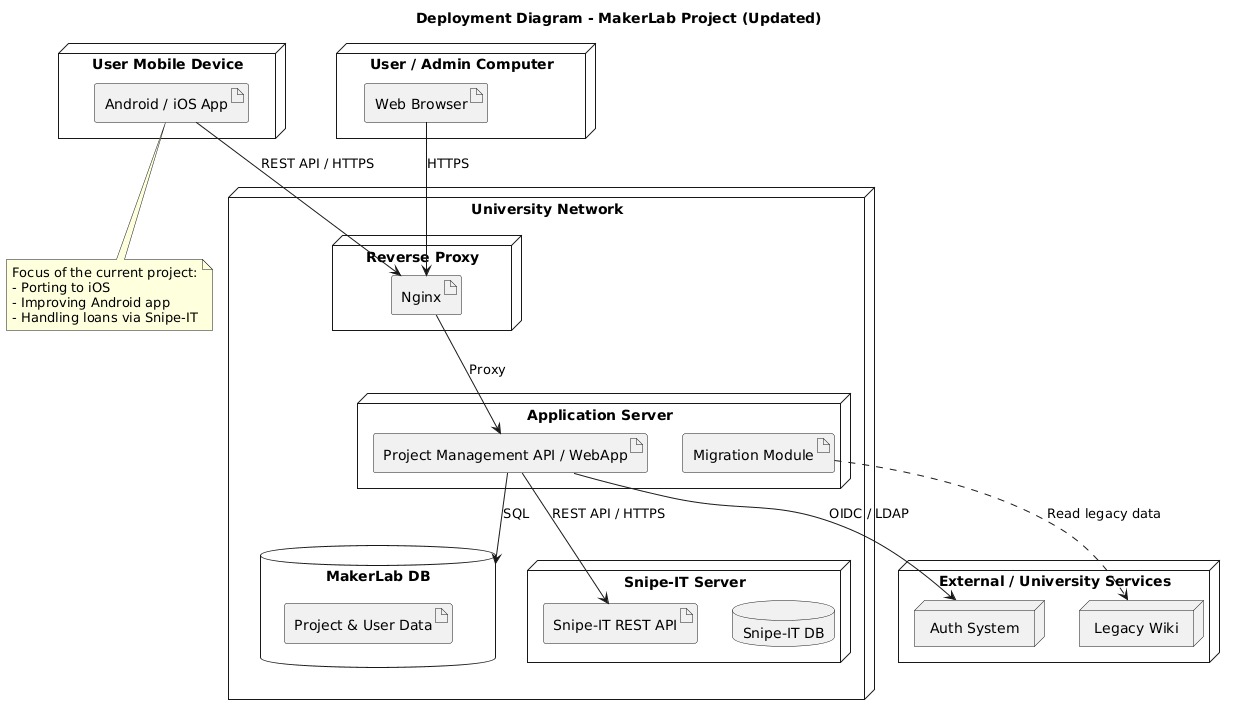
The current baseline consists of the following logical components:
| Component | Responsibility |
|---|---|
| Web client | Browser-based access for students, supervisors, and lab technician |
| Mobile clients | Android and iOS access for project-oriented workflows |
| Reverse proxy | Entry point, request routing, and boundary protection |
| Application server | Business rules, requisition workflow, project management, integrations |
| PostgreSQL database | Persistent storage for application-domain data |
| Snipe-IT | Inventory authority for assets and equipment availability |
| University SSO | User authentication |
| Migration module | Legacy data import from previous system |
Main communication paths
The most important communication paths in the system are:
- client → reverse proxy
- reverse proxy → application server
- application server → PostgreSQL
- application server → Snipe-IT REST API
- application server → authentication service
- migration module → legacy data source during migration windows
Why the architecture is split this way
The strongest architectural decision is the split between:
- inventory management, handled by Snipe-IT;
- project workflow and traceability, handled by the Maker Lab application.
This avoids duplicating inventory logic while still allowing the project to implement its own domain workflow, approvals, history, and reporting.
Baseline diagram
The current deployment-oriented architecture is illustrated below.